Why Zen Barbell Balances Growth and Peace?

In the chaotic symphony of the modern financial landscape—caught between rapid-fire social media “tips” and the rigid, often opaque traditions of old-school wealth management—we must ask a fundamental question: What is this money actually for? Most people view investing as a math problem to be solved with a better spreadsheet. I view it as a structural challenge to be mastered through a robust philosophy. To thrive in a high-growth but high-volatility economy, you need more than just a “portfolio.” You need an architecture that protects your peace while fueling your potential. I call this framework the Zen Barbell. So in this post, let’s dive into why the Zen Barbell balances growth and peace?
Contents
- 1 Related Posts: Why Zen Barbell Balances Growth and Peace?
- 2 Why Zen Barbell Balances Growth and Peace?
- 2.1 1. The Fragility of the “Moderate” Middle
- 2.2 2. Pillar One: The Equity Pyramid (The Growth Engine)
- 2.3 3. Pillar Two: The “Enough” Line (The Psychology of Fulfillment)
- 2.4 4. Pillar Three: The Bond Reservoir (The Mechanics of Peace)
- 2.5 5. The Antifragile Mindset (Thriving in Volatility): How Zen Barbell Balances Growth and Peace
- 2.6 6. The Mechanics of the Rebalancing Flow
- 2.7 7. Strategic Allocation: The Visionary/Realist Balance
- 2.8 8. The Philosophy of “Finding Fulfillment”
- 3 Conclusion: Why Zen Barbell Balances Growth and Peace?
Related Posts: Why Zen Barbell Balances Growth and Peace?
- 5 Ways to Achieve Financial Independence
- 5 Ways to Break-free from the Poverty Mindset
- Why Frugality Makes Sense?
- 6 Steps to Becoming a Millionaire by Saving
- 7 Reasons People Don’t Find Purpose in Life
- Why Most People Hate Their Jobs?
- There is More to Retiring Early Than You Think
- 5 Steps to Find Fulfillment in Life
Why Zen Barbell Balances Growth and Peace?
1. The Fragility of the “Moderate” Middle

In any complex system, the middle is often the most dangerous place to be. As Nassim Taleb popularized in his concept of Antifragility, a “moderately” exposed system often remains the most fragile because it lacks the protection to survive a catastrophe and the concentration to benefit from a breakthrough.
Most retail portfolios look “mushy.” Investors hold a bit of everything—some large caps, some gold, a few trending thematic funds—without a clear understanding of the purpose of each asset. When the markets dip, these investors feel the sting because they lack robust safety. When markets soar, they feel they are missing out because they lack concentrated growth.
The Zen Barbell rejects the middle path. Instead, it balances two extremes: Absolute, Unshakeable Safety on one side and Aggressive, Visionary Innovation on the other. By splitting your financial life this way, you remove the anxiety of the “mushy middle.” You become a Realist about your survival and a Visionary about your future.
2. Pillar One: The Equity Pyramid (The Growth Engine)
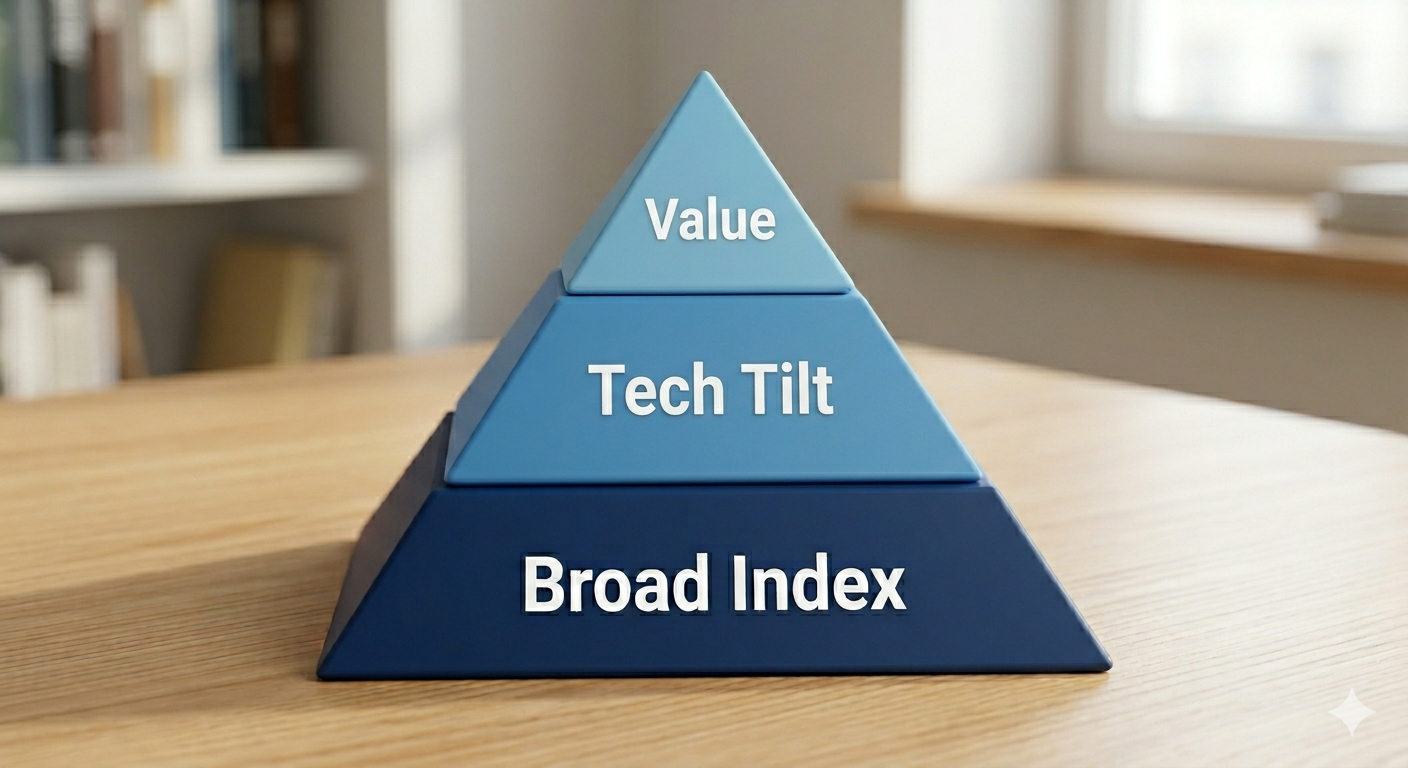
When we look at the “Growth” side of the barbell, we need a structure that transcends the noise of the daily news cycle. I visualize this as a three-tier Equity Pyramid. This strategy ignores “market timing” and instead focuses on “time in the market” through a disciplined hierarchy.
The Broad Index: The Bedrock
The base of the pyramid—the largest section—comprises the Broad Index. This represents the titans of industry—the companies that form the backbone of credit, consumption, and infrastructure. This foundation ensures that the global growth story never leaves you behind. It acts as the anchor that prevents the ship from drifting during a storm. Because this layer captures the “average” return of the entire market, it requires very little mental energy, freeing you to focus on other drivers of fulfillment like Learning and Purpose.
The Tech and Innovation Tilt: Capturing the Future
Above the foundation, I apply a strategic Tech Tilt. We live in an era of exponential displacement. From the AI revolution to the shift toward renewable energy and digital infrastructure, some companies move faster than the rest of the world. A Barbell strategy allocates a portion of the equity side to these high-velocity sectors to capture the “Alpha” of technological evolution. This visionary side of the barbell seeks to fund your Self-Actualization by participating in the greatest ideas of our time.
The Value Layer: The Realist’s Check
At the top sits Value. In a market that narratives and “hype” often drive, value investing—finding companies with strong cash flows and consistent business models—acts as a stabilizer. When growth stocks become overextended, the Value layer provides a margin of safety. It serves as the “Realist” cap on the “Visionary” pyramid, ensuring that your portfolio remains grounded in economic reality even when the “Innovation” side becomes exuberant.
3. Pillar Two: The “Enough” Line (The Psychology of Fulfillment)
The biggest tragedy in finance isn’t a market crash; it’s an investor who “makes it” but still lives in a state of scarcity. Without a defined finish line, the race for wealth becomes a treadmill that leads to burnout, not fulfillment. To achieve peace, you must define your “Enough Line.”
The Enough Line represents a psychological and mathematical boundary unique to every individual.
- Below the Line (The Security Zone): This money funds your baseline existence—your home, your health, and your family’s future. This money is sacred. You must handle it with extreme caution because a loss here affects your quality of life. In terms of our 10 Drivers, this secures Livelihood and Health.
- Above the Line (The Freedom Zone): Once you mathematically secure your “Enough,” the stakes of the game change. You no longer need to take risk to survive, which gives you the psychological permission to take more risk to thrive. In the Freedom Zone, you can afford to be an “Aggressive Visionary” because your survival remains untouched. This is where Leisure and Selfless Contribution begin to flourish.
When you live in the Freedom Zone, you stop playing the “comparison game.” You realize that an extra 2% return won’t change your Tuesday afternoon, but it might add unnecessary stress to your Monday morning. By defining your enough, you buy back your mental bandwidth.
4. Pillar Three: The Bond Reservoir (The Mechanics of Peace)
How do we maintain “Zen” when the stock market drops 30%? We don’t do it through “willpower.” We do it through Liquidity. In any market, volatility exists as a feature, not a bug. Most investors fail because they stay “paper rich and cash poor.” When a life emergency happens or a market opportunity arises, they must sell their long-term equity holdings at the worst possible time.
The Bond Reservoir creates a “bypass” system for your cash flow.
Instead of funneling every spare dollar into the volatile stock market, we fill the Reservoir first. This pool consists of high-quality, liquid debt instruments and short-term bonds.
- It protects the “Enough Line”: It ensures that non-volatile assets always fund your immediate future.
- It provides “Dry Powder”: When the inevitable “Black Swan” event occurs and the market panics, the Zen investor doesn’t look for the exit. They have the liquidity to stay the course—and the courage to buy the dip. This reservoir manifests Gratitude mechanically—you feel thankful for the stability rather than fearful of the change.
5. The Antifragile Mindset (Thriving in Volatility): How Zen Barbell Balances Growth and Peace
The Zen Barbell aims to transition you from a state of “fragility” to a state of antifragility. A fragile system breaks under stress. A robust system survives stress. An antifragile system gets better because of stress.
When you balance your barbell properly, your relationship with “bad news” changes fundamentally. In a traditional, middle-ground portfolio, a 20% market correction creates a crisis. In a Barbell portfolio, it creates a rebalancing opportunity. Because you secured your “Enough” in the Reservoir, you don’t view a crash as a threat to your livelihood; you view it as a “sale” on the future innovation your Pyramid captures.
This mindset shift represents the highest form of financial fulfillment. It allows you to remain the calmest person in the room when everyone else panics. It turns the inherent chaos of the economy into a tool for your growth, rather than a threat to your survival.
6. The Mechanics of the Rebalancing Flow
A Barbell is not a “set and forget” structure; it is a living system that requires periodic maintenance. However, rules—not emotions—must govern this maintenance.
The Bypass Rule
Whenever new income enters your life—whether through a salary, a bonus, or business profits—it must pass through the Bypass Filter.
- Step 1: Check the Bond Reservoir. Does it meet its target “Peace Level” (e.g., 2 years of expenses)? If not, flow 100% of new income there.
- Step 2: Once you fill the Reservoir, open the “bypass” and flow new income into the Equity Pyramid.
The Harvesting Rule
When the “Growth” side of the barbell becomes overextended (for example, if a Tech Tilt goes on a massive bull run), we “harvest” the excess. We sell a portion of the winners and move that capital back into the Reservoir. This ensures that as you get wealthier, your foundation becomes more unshakeable. You effectively “buy” your future peace using the profits of today’s innovation.
7. Strategic Allocation: The Visionary/Realist Balance
While specific percentages remain deeply personal, the philosophy often settles into a balance between your future potential and your current security. Imagine a world where you focus the vast majority of your equity strategy on the long-term (the Pyramid), while you keep a specific, high-liquidity amount in the Reservoir for absolute peace of mind.
This isn’t just about diversification; it’s about contextualizing risk. The stability of the Reservoir allows the Pyramid to be as aggressive as it needs to be. Without that safety net, every market dip feels like a personal threat. With it, every dip feels like a strategic opportunity. This balance allows you to maintain your Relationships and Quality of Life even when the economic climate turns harsh.
8. The Philosophy of “Finding Fulfillment”
We spend the first half of our lives trading our health and time for money. The ultimate tragedy occurs when we spend the second half of our lives trading our money to get our health and time back. The Zen Barbell prevents that tragedy. It builds on the core drivers of fulfillment:
- Livelihood & Quality of Life: The Broad Index and the “Enough Line” secure these.
- Health & Relationships: The Bond Reservoir protects these, ensuring financial stress doesn’t bleed into your physical or social well-being.
- Leisure & Learning: These become possible only when you free your mind from the constant anxiety of a flickering ticker tape.
- Selfless Contribution & Self-Actualization: These form the ultimate goal of the “Freedom Zone,” where your wealth becomes a tool for impact rather than just a scorecard.
Wealth is not the destination; it is the fuel. If your investment strategy requires you to check your phone every ten minutes, it is a bad strategy, no matter the returns.
Conclusion: Why Zen Barbell Balances Growth and Peace?
Building a Zen Barbell isn’t a one-time event; it’s a lifestyle shift. It requires the discipline to say “No” to the latest hot trend and the courage to say “Yes” to a long-term vision. One side of the barbell keeps you safe; the other side keeps you dreaming. Everything in between is just noise.
The goal isn’t to be the richest person in the graveyard. The goal is to be the most fulfilled person in the room. The path to financial fulfillment doesn’t lie in a complex algorithm. It lies in the balance of the Barbell. One side protects your “Now,” while the other side builds your “Next.”
Are you ready to draw your “Enough Line”? What is the one thing that prevents you from feeling “Zen” about your finances today? Let’s start the conversation in the comments below. We are here to build wealth that serves life, not a life that serves wealth.
Leave a Reply
You must be logged in to post a comment.